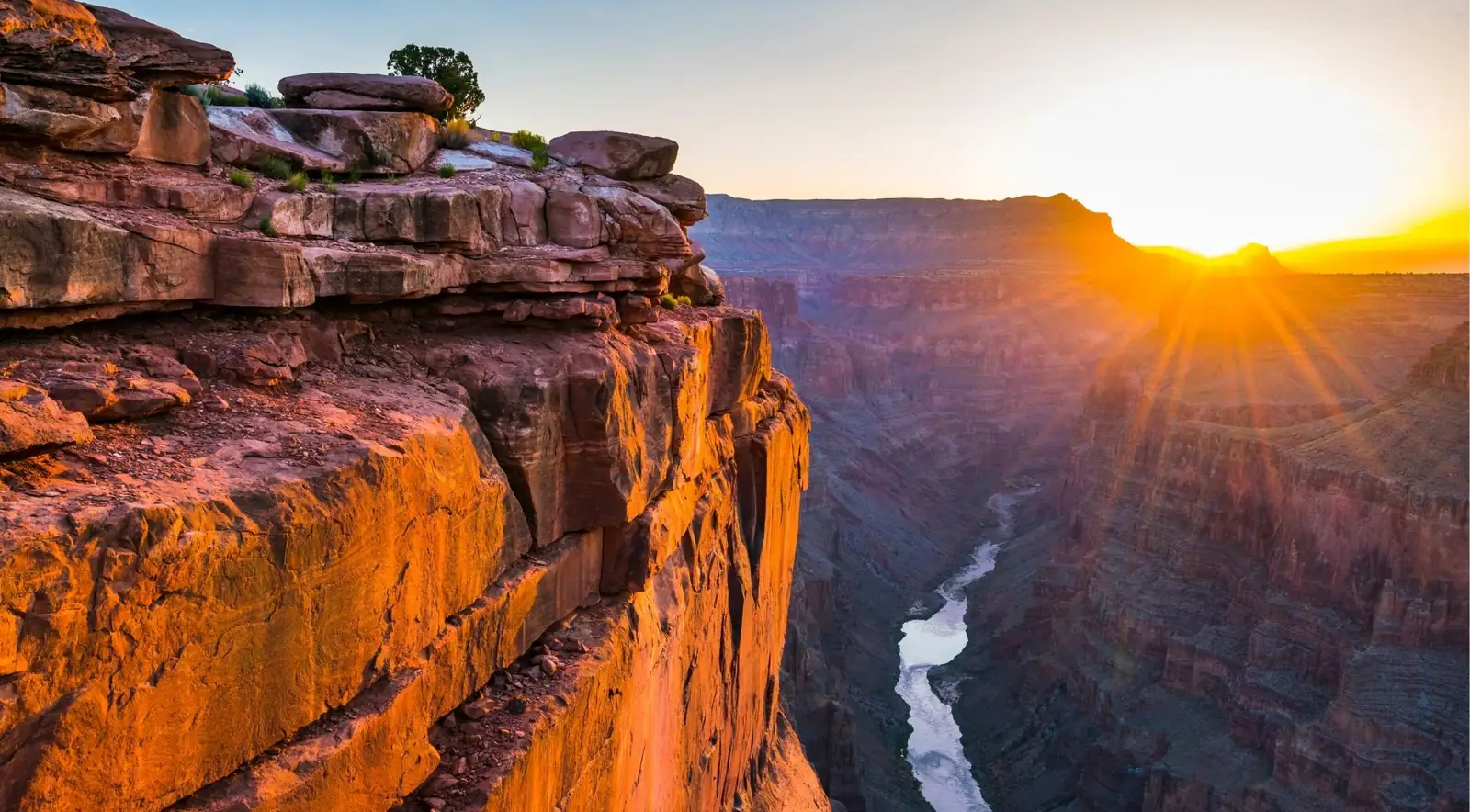
- 3,300 ftDescent below the rim
- 1,450 ftLanding site elevation
- 30 minTypical time on the floor
- 20–30°FHotter than the rim
- 600 × 150 ftSize of the landing area
The Entire Product Rests on One Legal Fact
Below-rim landing is banned throughout the national park. Grand Canyon West is not in the national park.
Everything on this page follows from that single fact. It is also why the page leads with a table rather than a description — because the most expensive misunderstanding in this category is not about price, it is about where the helicopter actually puts its skids down. Get that settled first, then read the rest.
Prices on this page are "from" rates captured in mid-2026 and exclude surcharges — the full fee stack, including fuel surcharges, comfort seats and gratuities, is in our helicopter tour price breakdown. For operators, aircraft models and the industry's safety record in full, see our helicopter tours guide.
Floor or Rim? Check Before You Book
Operators rename and reposition products regularly. Confirm the landing type in writing before you pay.
| Tour | Operator | Lands where? |
|---|---|---|
| Grand Celebration | Papillon | Canyon floor |
| Over the Edge (heli + boat) | Papillon | Canyon floor |
| Grand Voyager | Papillon | Canyon floor |
| VIP Heli, Boat & Skywalk | Papillon | Canyon floor |
| Wind Dancer | Maverick | Canyon floor |
| Wind Dancer Sunset | Maverick | Canyon floor |
| Grand Canyon Discovery | Maverick | Canyon floor |
| Indian Territory | Maverick | Canyon floor, then rim |
| Western Journey | Maverick | Rim only |
| "Eagle Point landing" products | Various | Rim only |
| Western Ranch Adventure | 5 Star | Ranch, not canyon |
The test: a genuine canyon-floor tour will state a descent of roughly 3,200 to 4,000 feet and describe a site near or above the Colorado River. If a listing says "lands at Grand Canyon West," "lands at Eagle Point," or simply "landing tour" without specifying a descent, assume it is a rim landing and ask. Get it in writing before you pay.
Other Las Vegas Day Experiences You Might Enjoy
A canyon-floor landing is the premium end of the category. Las Vegas also puts the Hoover Dam, Lake Mead and the Colorado River within a morning's reach, along with coach and small-group day tours to Grand Canyon West, the glass Skywalk at Eagle Point, and pontoon-boat trips on the river itself. Browse well-reviewed options below if you are still weighing a flight against a day on the ground.
Why You Can Only Land Here
The rule that makes this product exist — and the limits of the exemption behind it.
The National Park Ban
Airspace over Grand Canyon National Park is governed by Special Federal Aviation Regulation 50-2, which created the Grand Canyon National Park Special Flight Rules Area — flight-free zones, mandatory corridors, curfews and a cap on air tour numbers.
Within the park, the Park Service prohibits commercial helicopters from landing below the rim entirely. The only below-rim flights permitted are law enforcement, firefighting, medical evacuation and park maintenance. Which is why, at the South and North Rims, the canyon floor is reachable only on foot, by mule, or by river raft.
Grand Canyon West Is Not in the Park
It sits on the Hualapai Indian Reservation, whose traditional lands include the lower 108 miles of the canyon. It is under tribal jurisdiction, not Park Service jurisdiction, so the below-rim landing ban does not apply. The FAA granted the tribe an exemption from the park-specific route, curfew and cap rules roughly two decades ago, having found those rules would damage an economy in which tourism is central.
To be precise about what that exemption covers: aircraft flying here remain fully subject to FAA airworthiness standards, pilot certification requirements and Part 135 commercial operating rules. What the tribe is exempt from is the national park's specific airspace management regime — not aviation safety regulation.
The Tribe Controls Access
Landing sites on the plateau are leased to individual operators, and the Hualapai sell Quartermaster Point permits through the Grand Canyon West terminal. Papillon's Quartermaster and Lower Ramada sites are leased and used exclusively by that operator; it has flown to the area since 1997, carrying over a million passengers across some 180,000 flights.
Could This Change?
It rests on tribal sovereignty and tribal economic policy, so it is stable in the near term — the tribe actively markets it. The plausible pressures are the tribe choosing to limit volume for cultural or sustainability reasons, a future regulatory intervention specific to below-rim operations, or the ongoing land-boundary questions near the river. None currently threaten the product.
The Landing Site: What It Is Actually Like
Marketing photography shows a helicopter alone on a plateau. These figures come from NTSB documentation.
| Specification | Figure |
|---|---|
| Location | Quartermaster Canyon area, south bank of the Colorado River, ~60 miles west of Peach Springs, Arizona |
| Landing area | Approximately 600 by 150 feet, on rough ground |
| Elevation | 1,450 feet above sea level |
| Below the rim | About 3,300 feet |
| Above the Colorado River | Around 300 feet |
You will see the descent advertised as 3,200 feet, 3,500 feet or 4,000 feet depending on the operator. These are the same site described from different rim reference points with different rounding — not different destinations.
The ground. Bare rock. The NTSB called it "rough ground," and Papillon's own guidance describes it as rough, rocky and uneven. There is no permanent structure. Shade comes from a ramada — a traditional open shade shelter — at the picnic area, and nothing else.
Wear proper shoes. Sneakers or hiking boots. Open sandals are a poor decision on this terrain.
How busy is it? Operators use separate leased pads within the same general area, and multiple aircraft can be on the ground simultaneously — Papillon's operation has scheduled ten helicopters arriving in sequence. At peak times you will not have the canyon to yourself. Note also that the NTSB found the area has no marked touchdown zones or fixed markers delineating landing areas; pilots choose orientation based on wind.
What Happens in Your Thirty Minutes
Time on the ground is 30 minutes on the flagship Las Vegas tours. The short products departing from the rim give you 20. Maverick's sunset Wind Dancer advertises extended time, around 45 minutes.
What you get: a champagne or sparkling wine toast and a light picnic, with soft drinks and bottled water, included in the fare. Morning departures on some tours add a continental breakfast. Non-alcoholic options are available.
A small note on accuracy: an older NTSB document described the picnic as including non-alcoholic sparkling wine, while current marketing for the flagship tours says champagne. What is poured may vary by tour and time of day.
What you can do: walk within a bounded area near the pad, take photographs, and talk to the pilot, who stays with the group. It is free time rather than a guided walk. Be realistic about the pace — reviewers routinely report having five to ten minutes to explore before being called over for the picnic.
Can you reach the river? No, on a standard landing tour. You are around 300 feet above it. The only way to reach the water is on a helicopter-plus-boat package, where a short walk takes you down to board.
The descent itself is the part people remember: a steep few minutes dropping between the canyon walls. On the short tour from Grand Canyon West airport, the flight is only about six minutes each way.
Photography is encouraged both airborne and on the ground. Selfie sticks and extending camera poles are banned in and around the aircraft. Separately, standalone and professional cameras are not permitted on the Skywalk itself, though phones have been allowed on the bridge since 2024.
Every Canyon-Floor Tour Compared
From Las Vegas, and from Grand Canyon West itself.
From Las Vegas
| Tour | From | Total | Floor time | Notes |
|---|---|---|---|---|
| Papillon Grand Celebration | $479 | 4–4.5 hrs | ~30 min | 70 min flight, hotel transport, champagne picnic |
| Maverick Wind Dancer | $599 | ~2 hr 20 | ~30 min | Strip flyover on return, EC130 guaranteed |
| Maverick Wind Dancer Sunset | $629 | ~2 hr 20 | ~45 min | Extended ground time, sunset Strip return |
| Maverick Indian Territory | $739 | ~4.5 hrs | ~30 min | Two landings — floor, then rim with Skywalk option (+$40) |
| Papillon Grand Voyager | $594 | ~7 hrs | Yes | Aeroplane out, helicopter descent, pontoon boat |
| Papillon VIP Heli, Boat & Skywalk | $819 | Full day | Yes | Floor landing, river boat and Skywalk |
From Grand Canyon West itself
| Tour | From | Total | Floor time |
|---|---|---|---|
| Maverick Grand Canyon Discovery | $279 | ~30 min | ~20 min |
| Papillon Over the Edge (heli + boat) | $309 | ~3 hrs | Yes, plus river |
The Discovery is the cheapest canyon-floor landing available — but you must get yourself to Grand Canyon West first, and you will need separate admission on top from around $67 (see our admission fees and tickets guide). If you are already visiting the West Rim for the day, it is outstanding value.
Smaller operators. Serenity flies a landing tour to a private site around 4,000 feet below the rim with a champagne picnic. Its current pricing was not verifiable on its own booking pages, so confirm directly. 5 Star's "landing" products are ranch and rim landings, not the Quartermaster canyon-floor experience — read carefully. Full pricing analysis including surcharges is in our Grand Canyon helicopter tour prices guide.
The Colorado River Pontoon Add-On
On combination packages, the helicopter drops you on the floor and a short walk takes you to the riverbank to board a pontoon boat.
What it is: a leisurely float on smooth water between the Quartermaster Canyon walls, commonly around 15 minutes on the shorter combos. Time for photographs and wildlife.
What it is not: whitewater. This is a calm cruise, not a rafting trip.
Availability: year-round, subject to weather and river conditions. Shoulder seasons are most comfortable.
Do not confuse this with the whitewater trip
The Hualapai River Runners one-day rafting trip is an entirely separate product and a completely different day.
| Pontoon add-on | Hualapai River Runners | |
|---|---|---|
| Departs | Grand Canyon West, by helicopter | Peach Springs / Hualapai Lodge |
| Getting to the river | Helicopter descent | 21-mile drive down Diamond Creek Road |
| Duration | ~15 minutes on the water | Full day, roughly 7am to 6pm |
| Water | Smooth, calm | Genuine whitewater, motorised raft |
| Extras | Champagne picnic | Hike to Travertine Cavern Falls, riverside lunch |
| Exit | Helicopter back to the rim | Helicopter lift out from the river |
| Minimum age | Varies | 8 |
Note the pleasing symmetry: the sightseeing tour flies you down and back, while the rafting trip drives you down and flies you out.
Adding the Skywalk
The Skywalk is at Eagle Point, on the rim — so reaching it requires a separate stop.
How It Works
On tours that include both — Maverick's Indian Territory, Papillon's VIP package, and various combos — you do the floor landing first, then the helicopter repositions you to Grand Canyon West on the rim, where the free shuttle connects Eagle Point, Guano Point and Hualapai Ranch.
Cost, Time and the Camera Rule
Cost: around $40 added to a Maverick tour, well below the $99 gate price for the All-Access Pass — see tickets and prices.
Time: budget a couple of extra hours. Reviewers consistently note that around 30 minutes at Eagle Point feels rushed.
Remember: cameras and phones are not permitted on the Skywalk. Lockers are provided. More in our Skywalk guide.
Hoover Dam Is on the Way
It Is Part of the Standard Flight Path
Every West Rim tour departing Las Vegas flies over or near Hoover Dam, the Mike O'Callaghan–Pat Tillman Memorial Bridge, Lake Mead and Fortification Hill, an extinct volcano.
This is part of the standard routing, not an add-on you need to pay for. If a listing sells "Hoover Dam" as an upgrade on a West Rim helicopter tour, you are being sold something you were getting anyway. No commercial tour lands at Hoover Dam — it is a flyover. If the dam itself is the draw, our Hoover Dam tours guide covers trips that actually stop there.
The Heat Is a Real Consideration
This is the main practical risk of a canyon-floor landing and it deserves plain language.
The Numbers
Temperature rises roughly 5.5°F for every 1,000 feet you descend. The canyon floor runs 20 to 30°F hotter than the rim. In summer the inner canyon regularly exceeds 100°F and can reach 106 to 110°F and beyond.
During a heat warning in June 2024, the Park Service forecast shade temperatures of 105°F and 111°F for areas below 4,000 feet. In direct sun it feels 15 to 20°F hotter than the posted shade temperature — and the landing plateau is exposed rock with a single ramada for shade.
Practical Consequences
Book a morning or sunset departure between May and September. Carry water and drink it. Hat, sunglasses, sunscreen, and cover your skin. Avoid midday summer landings — worst heat, flattest light.
Best months are March to May and September to November: comfortable floor temperatures, good light, fewer weather disruptions. Our month-by-month guide goes through the year in full.
Practical Requirements
Physical
You must be able to climb two steps of around 18 inches into the aircraft — crew cannot lift passengers except in an emergency — and walk on rough, uneven rock. There is no hiking involved, but nothing is paved.
Accessibility
Most canyon-floor landing tours are not wheelchair accessible. Passengers must transfer into the aircraft themselves, and the shuttle vehicles generally lack lifts. Anyone needing assistance should travel with a companion and confirm the specifics with the operator before paying.
Children
Infants under two typically fly free on a lap; from age two a child pays an adult fare. The landing itself is family-friendly, but the heat and the short exposed ground stop are worth weighing for small children.
What to Bring
Sturdy closed-toe shoes, layers appropriate to the season, sunglasses, sunscreen, hat, water, camera, and photo ID for anyone 18 or over.
Weather, Wind and Cancellations
High winds — commonly cited at around 35 mph and above — and poor visibility will ground flights.
Three things can happen:
- The tour flies as booked
- The landing is cancelled and the tour converts to air-only
- The whole flight is cancelled
If the operator cancels for weather, you are rebooked at no charge or refunded. That is standard and it is your protection. Customer-initiated cancellations are a different matter — windows range from 24 hours to four days depending on the product, so check yours.
Monsoon season, July to September, brings afternoon thunderstorms, delays and rough air. Morning departures are markedly more reliable in those months.
Practical advice: book early in your Las Vegas stay so a weather rebooking still fits your trip.
Is the Landing Worth the Premium?
The gap is smaller than you might think.
An air-only West Rim helicopter tour starts around $449. Papillon's flagship floor-landing tour starts at $479. At those rack rates it is a $30 step up. Compared across operators and resellers the premium is more typically $100 to $250.
What reviewers consistently say: it is the highlight of the trip. The phrase that recurs is some version of feeling like a different planet. The descent, the silence on the floor, and the sheer scale of the walls above are what people remember. It is also, short of hiking or rafting, the only way to stand at the bottom of the Grand Canyon.
What they consistently complain about:
- Thirty minutes is short. Several report only five to ten minutes of actual exploring before the picnic
- Summer heat
- A minority find the champagne gimmicky
- The site can feel crowded with several helicopters down
- Some discover too late that their tour landed at the rim, not the floor
Who should book it
This Is a Bucket-List Trip
You are coming from Las Vegas, and standing at the bottom matters more to you than maximum aerial mileage.
You Want the Most Canyon per Pound
Budget is tight, you are prone to airsickness, or you want maximum coverage. An air-only West Rim flight, or a South Rim flyover covering far more terrain, delivers more scenery for the money.
You Mainly Want to See the Canyon
If the viewpoints are the point, a coach tour or self-drive to the West Rim costs a fraction as much.
You Want to Be On the River
If being on the water rather than briefly above it is the appeal, the Hualapai whitewater day is the better purchase.
Safety on the Approach
Confined Terrain, Shifting Winds
Our helicopter tours guide covers the industry's safety record properly. What is specific to landings is this: below-rim landings put aircraft into confined terrain where winds shift unpredictably and downdrafts are possible.
In February 2018, a Papillon EC130 crashed on approach to the Quartermaster site; the NTSB's final report attributed it to a loss of tail rotor effectiveness and subsequent loss of control while landing in gusting tailwind conditions in an area of potential downdrafts and turbulence. Five people died. The report also noted the site had no marked touchdown zones and that the operator had not issued written guidance on approach profiles for given wind conditions. Papillon subsequently fitted crash-resistant fuel cells across its fleet, and a $100 million settlement was approved in 2024.
How operators manage it now: published wind limits, sequenced arrivals, canyon-experienced pilots, and converting to air-only or cancelling when conditions exceed limits.
What that means for you: book mornings, when winds are calmest. And when an operator cancels or downgrades your landing for weather, accept it. That decision is the system working.
Grand Canyon Helicopter Landing Tour from Las Vegas
Papillon's Grand Celebration — the flagship door-to-door canyon-floor landing on the EC130 EcoStar, and the cheapest genuine floor landing from Las Vegas. A 70-minute flight out over Lake Mead and Hoover Dam, a descent of roughly 3,300 feet to the Quartermaster site beside the Colorado River, and a champagne picnic on the floor. Rated 4.8 / 5 from 1,800+ travellers.
- Round-trip helicopter flight from Las Vegas
- Genuine canyon-floor landing — not a rim landing
- Champagne toast and light picnic on the canyon floor
- Hotel pickup from the Las Vegas Strip
Free cancellation up to 24 hours before departure via GetYourGuide.
Check Availability & PricesFree cancellation · Instant confirmation
West Rim Helicopter Landing Tours: FAQ
Can you land in the Grand Canyon by helicopter?
Only at the West Rim, on Hualapai tribal land. Landing below the rim is prohibited throughout Grand Canyon National Park.
Why can helicopters land at the West Rim but not the South Rim?
Grand Canyon West is on the Hualapai Indian Reservation, under tribal rather than National Park Service jurisdiction, and the FAA granted the tribe an exemption from the park's airspace restrictions.
How far down does the helicopter go?
Around 3,300 feet below the rim, to a plateau at about 1,450 feet elevation, roughly 300 feet above the Colorado River.
How long do you spend on the canyon floor?
Thirty minutes on most Las Vegas tours, 20 on the short flights from Grand Canyon West, and around 45 on Maverick's sunset tour.
What do you do down there?
Walk a bounded area near the pad, take photographs, and have a champagne toast and light picnic under a shade shelter. It is free time rather than a guided tour.
Can you touch the Colorado River?
Not on a standard landing tour — you are about 300 feet above it. Only helicopter-and-boat packages take you down to the water.
How much does a canyon-floor landing tour cost?
From $479 from Las Vegas, or from $279 if you are already at Grand Canyon West. Air-only tours start around $449.
Is the landing worth the extra money?
Most reviewers say yes, and the premium can be as little as $30 at some rack rates. If budget is tight or you want maximum aerial coverage, air-only is the better buy.
How hot is it on the canyon floor?
Around 20 to 30°F hotter than the rim. Summer regularly exceeds 100°F and can pass 110°F. Book mornings or sunset between May and September.
What should I wear?
Sturdy closed-toe shoes for rough rock, plus layers, sun protection and water.
Are landing tours wheelchair accessible?
Generally not. Passengers must board the aircraft themselves and shuttles usually lack lifts. Contact the operator directly.
Do landing tours include the Skywalk?
Some do. It is on the rim, so it requires a separate stop, and it typically costs around $40 added to a tour — considerably less than the $99 gate price.
What happens if wind stops the landing?
The tour may convert to air-only or be cancelled entirely. Operator cancellations are rebooked free or refunded.