- ~45 minFlight each way to West Rim
- 4–5 hrsTypical hotel-to-hotel
- $399+Air-only flyover
- $479+Canyon-floor landing
- +15–30%Typical fees above headline price
Three Things That Will Save You Money and Disappointment
You will not find these on most booking pages. First: the company you book with is probably not the company flying you — a handful of operators own the helicopters, and everyone else is reselling their seats. Second: no helicopter flies from Las Vegas to the South Rim. It is out of range. Every Vegas helicopter tour goes to the West Rim, and that is a different place from the canyon in the postcards. Third: the price you see is not the price you pay — fuel surcharges, comfort seats and tribal fees typically add 15 to 30 per cent at check-in.
From the rim, even experienced hikers rarely see more than a sliver of the canyon. From a helicopter at cruising altitude you see the full scale of the Colorado River's work — billion-year-old Vishnu Schist at the bottom, Kaibab Limestone at the top, every geological era between. A helicopter also turns a grinding 11–13-hour bus day into a 4–5-hour experience, reaching the West Rim in about 45 minutes each way instead of 2.5 hours by road.
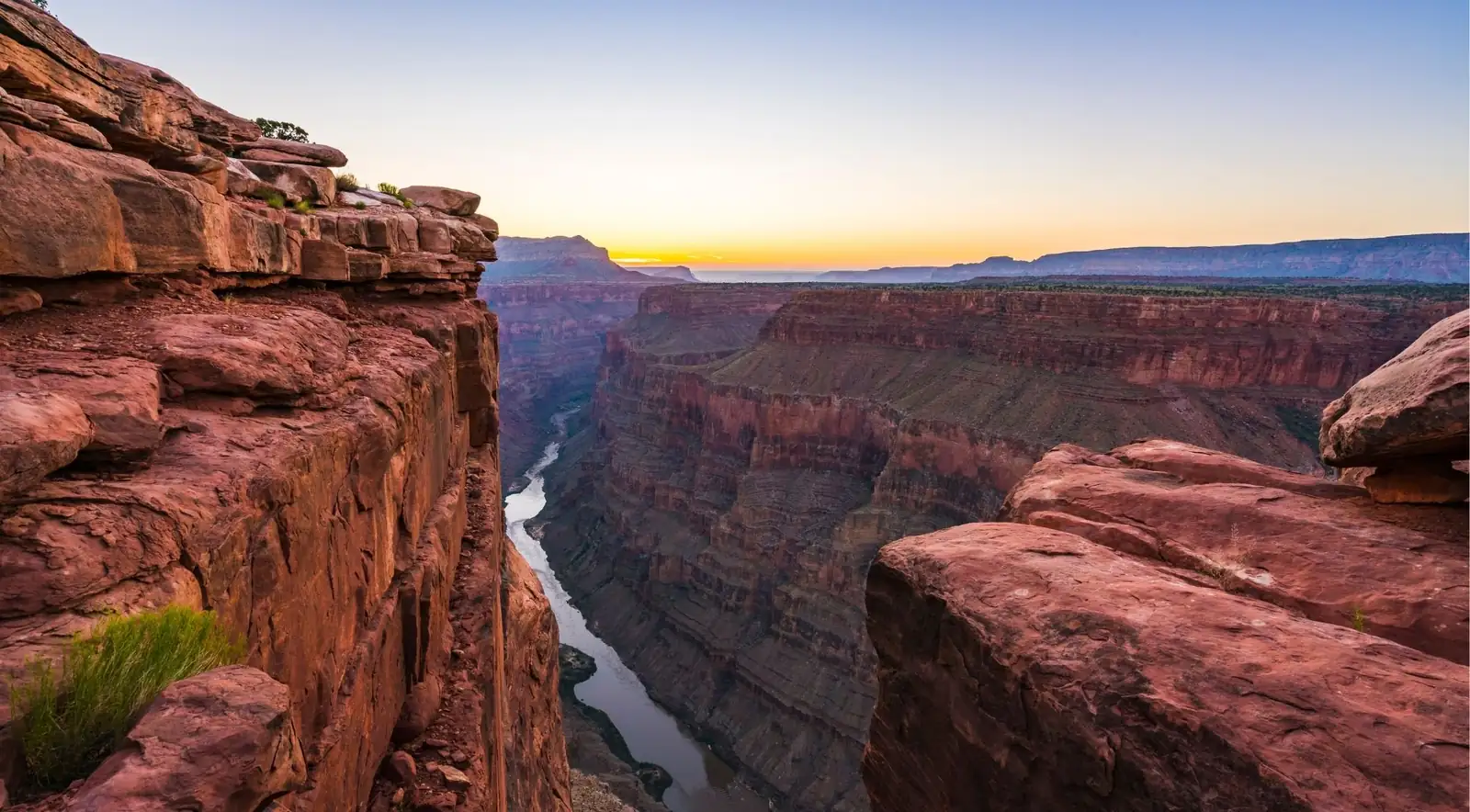
And there is one thing no other Grand Canyon experience offers: landing on the canyon floor. Below-rim landings are prohibited by the National Park Service at the South and North Rims. At the West Rim — Hualapai tribal land outside the National Park — landings on a private bluff above the Colorado River are permitted. That exclusive access is what makes West Rim helicopter tours genuinely unique.
Operators vs Resellers
Search "Las Vegas helicopter tours" and you will find dozens of companies. Most of them do not own a single aircraft.
An Operator
Holds an FAA Part 135 certificate, owns and maintains helicopters, employs the pilots, and has a physical terminal you can drive to.
A Reseller or Broker
Sells seats on somebody else's aircraft. This is disclosed, but usually in fine print — look for wording along the lines of "we do not own or operate aircraft."
Sometimes Considerably
When weather cancels your flight, an operator can move you to another aircraft in its own fleet. A broker has to renegotiate with the operator. You also may not know which aircraft model you are getting until you arrive — and as you will see below, that matters a great deal. Resellers are not a scam. Some are excellent, and OTAs like Viator and GetYourGuide vet their listings. But you should know which you are dealing with before you pay.
Other Las Vegas Experiences You Might Enjoy
Las Vegas is the gateway to some of the most spectacular scenery in the American Southwest — from Grand Canyon West helicopter canyon-floor landings and the Colorado River to the Hoover Dam, Lake Mead, Fortification Hill and the Hualapai Skywalk at Eagle Point. Browse well-reviewed options below for ideas to complement your helicopter day.
Who Actually Flies
Papillon Grand Canyon Helicopters
The oldest and largest. Founded in 1965 by Elling Halvorson, whose crews had used helicopters to build a trans-canyon water pipeline for the National Park Service and realised the aircraft could carry sightseers instead. Still family-owned; Halvorson died in 2020 aged 88, and his daughter Brenda Halvorson has run the company for around 25 years, growing it from 17 helicopters to a group fleet of roughly 90 aircraft including fixed-wing.
Departure: Boulder City terminal, with hotel shuttles from the Strip and downtown. Fleet: mixed — EC130 B4 and T2, AS350 B2 and B3e, Bell 206L, MD900, plus Twin Otter and Cessna Caravan aircraft.
Notable: Papillon is the only operator in the Las Vegas market that is a current member of the Tour Operators Program of Safety. Its scale also means the widest schedule and the best odds of same-day rebooking if weather intervenes. Watch for: because the fleet is mixed, "helicopter" does not guarantee an EcoStar. Ask.
Maverick Helicopters
Founded in December 1995 by Greg and Brenda Rochna — Greg a former US Army helicopter pilot — and flying since 1996.
Departure: its own terminal on Las Vegas Boulevard at the south end of the Strip. This is the key structural advantage: minimal transfer time, and a Strip flyover included on every tour. Fleet: all Airbus H130/EC130 EcoStar, around 50 aircraft — reportedly the world's largest fleet of the type. Over 560,000 flight hours; more than 225,000 guests a year.
Notable: no fatal accident on record. Winner of the FAA's Diamond Award for aviation maintenance excellence for fourteen consecutive years through 2024. Watch for: premium pricing — you pay for the aircraft guarantee and the location.
Serenity Helicopters
A small Boulder City operator with 25-plus years of history, flying AS350 AStars. Mercedes Sprinter transfers, small groups, its own terminal. A boutique alternative to the two giants.
Note: Serenity markets a perfect safety record. That is a marketing claim rather than an independently verified statistic — as are all such claims in this industry.
5 Star Grand Canyon Helicopter Tours
Budget-focused, operating from Boulder City and North Las Vegas, and behind many of the cheap Strip night flights sold through OTAs. Reviews are genuinely mixed: transfers earn praise, while long waits, seat assignments with obstructed views and rebooking friction come up repeatedly.
The Specialists
Skyline Helicopter Tours and FlyNYON offer doors-off flights for photographers. Gunship Helicopters runs an open-door aerial shooting experience. None of these fly the standard Grand Canyon landing tours.
A Warning About Sundance
Sundance Helicopters was once the largest operator in Las Vegas, carrying around 160,000 passengers a year from Strip-adjacent departures with limousine transfers. It was acquired by Air Methods in 2012 for $44 million. Sundance permanently closed its Las Vegas tourism flight operations in August 2020, citing the collapse in tourism.
You will still find Sundance tours advertised across the web in 2026. Those listings are stale, or belong to resellers who have not updated their pages. If a site is still selling Sundance, treat everything else on it with suspicion.
The Aircraft Matters More Than You Think
This is the single biggest determinant of your experience, and most listings do not mention it.
Airbus EC130 / H130 "EcoStar"
Purpose-built for sightseeing. Seats up to seven passengers plus pilot in forward-facing theatre seating, with wraparound windows giving roughly 180-degree views from every seat. Air conditioned, with individual headsets for pilot narration. Its enclosed Fenestron tail rotor is around 50% quieter than a conventional one, and the cabin is about 23% larger than the older AStar. On an EcoStar, there are no bad seats.
AS350 AStar
The EcoStar's predecessor. Smaller cabin, louder conventional tail rotor, and some seating configurations are less favourable. Entirely safe and comfortable — just a clear step down for sightseeing.
Bell 206 JetRanger / LongRanger
Older still. Smaller windows and, in some configurations, side- or rear-facing seats. The weakest option for a scenic flight.
The Front Seat Is Not Guaranteed
The front co-pilot seat has the best forward view and is often sold as an upgrade at around $50 to $60. Be aware that seat assignments are made by the operator for weight and balance, and requests — even paid ones — are not guaranteed. Some landing tours rotate passengers between front and back at the halfway point.
The 1987 National Parks Overflights Act
The Act established a "natural quiet" standard for the Grand Canyon, after which quiet-technology aircraft became effectively mandatory for commercial operations over the canyon. The EcoStar was designed with that requirement in mind.
Where You Actually Depart From
| Departure point | Operators | Drive from Strip | Trade-off |
|---|---|---|---|
| Boulder City Airport | Papillon, Serenity, 5 Star | 25–40 min | Cheaper; longer day; no outbound Strip flyover |
| Las Vegas Boulevard terminal | Maverick | Minimal | Pricier; Strip flyover included; shorter day |
| Henderson Executive / Harry Reid | Various, situational | — | Private charters and VIP products |
| Grand Canyon West Airport | Various | — | Tours starting at the canyon, not Vegas |
| Grand Canyon National Park Airport (Tusayan) | Papillon and others | — | Genuine South Rim air tours |
Boulder City shuttles collect you 60 to 90 minutes before flight time — sometimes up to two hours for sunset departures. That is dead time you should factor into your day. The practical rule: if you are short on time, pay for a Strip departure. If you are price-sensitive, Boulder City is the same canyon for less money and a longer day. More on transport logistics in Las Vegas to the Grand Canyon Skywalk.
Every Type of Tour, Explained
| Tour type | Flight time | Total day | Roughly |
|---|---|---|---|
| Strip night flight | 10–15 min | 1–2 hrs | $95–$129 |
| West Rim, air only | ~70 min | 3.5–4 hrs | $399–$449 |
| West Rim with canyon-floor landing | ~90 min | 4–4.5 hrs | $479–$729 |
| Landing plus Skywalk | ~90 min | 5+ hrs | $629+ |
| Landing plus pontoon boat | ~90 min | 6–7 hrs | $800+ |
| Bus and helicopter combo | ~15–30 min | 10–14 hrs | $250–$400 |
| South Rim air tour | ~45 min | 9–10 hrs | Varies |
| Private charter | Your call | Your call | By the hour |
Strip night flights are city-only: ten to fifteen minutes over the Boulevard after dark. Cheap, brief, and genuinely thrilling.
West Rim air-only tours fly out over Lake Mead and the Hoover Dam, into the canyon, and back without landing. Good if you are short on time; the flight is the whole product.
West Rim landing tours are the signature experience — descending three thousand feet or more to a private plateau near the Colorado River for around thirty minutes on the ground, usually with a champagne toast. This is the only place in the entire Grand Canyon where helicopters may land below the rim, because it is Hualapai tribal land rather than national park.
Landing plus Skywalk adds ground transport to the glass bridge. The Skywalk admission is often an extra charge on the day rather than bundled — confirm. See our Skywalk tickets & tours guide.
Bus and helicopter combos coach you to the West Rim and add a short below-rim flight. It is by far the cheapest way to get a helicopter into your Grand Canyon day — see Las Vegas to Grand Canyon tours.
South Rim air tours need explaining, because the marketing is misleading. These fly the Dragon Corridor over the deepest part of the canyon, and they are magnificent. But they depart from Tusayan, Arizona, not Las Vegas. A "South Rim helicopter tour from Las Vegas" means a fixed-wing flight to Tusayan first, then a helicopter — a nine to ten hour day. National Park rules prohibit landing below the rim there.
What You Actually See
From Boulder City or the Strip, the route runs southeast over Lake Mead, past the Hoover Dam and the Mike O'Callaghan–Pat Tillman Memorial Bridge, over Fortification Hill — an extinct volcano — then across the Colorado River and the Grand Wash Cliffs, which mark the western entrance to the Grand Canyon.
Once out of the Las Vegas metro area, every operator flies the same FAA-designated corridor. The view is the view.
Each leg is around 45 minutes. On a landing tour, the helicopter descends to a Hualapai plateau roughly 300 feet above the river, where you spend about half an hour on the ground.
A Strip flyover runs the length of Las Vegas Boulevard at low altitude — the Sphere, the Bellagio fountains, the Luxor beam, the High Roller, the Strat.
Grand Canyon Helicopter Landing Tour from Las Vegas
The best-balanced canyon-floor landing tour we track — an EcoStar flight from Las Vegas over Lake Mead and Hoover Dam, then a descent 3,200 feet below the rim to land beside the Colorado River for a champagne picnic. Optional Strip hotel transfers and a sunset departure upgrade. The single moment reviewers describe as "life-changing": stepping out onto the bluff, canyon walls on three sides, silence broken only by the river.
- Scenic EcoStar flight to Grand Canyon West
- Canyon-floor landing beside the Colorado River
- Champagne picnic on the canyon floor
- Noise-cancelling headsets + pilot narration
- Optional hotel transfers & sunset upgrade
You will be weighed at check-in. A 300 lb per-passenger threshold applies, and a comfort seat is charged above it.
Free cancellation up to 24 hours before departure · Secure checkout via GetYourGuide
More Grand Canyon Helicopter Tours from Las Vegas
From a budget air-only flyover to the all-in VIP heli, boat & Skywalk — book directly below.
Wind Dancer: Landing Tour & Champagne
Maverick's flagship and the most-reviewed Grand Canyon helicopter experience — descend 3,500 ft below the rim, land, and toast with champagne on the canyon floor. All-EcoStar fleet, Strip terminal, Strip flyover included.
Grand Canyon Helicopter Air Tour
A 70–75-minute air-only flight over Hoover Dam, Lake Mead and the West Rim — the entry-level option if the flight itself, not the landing, is your priority.
Grand Canyon Skywalk Express Helicopter Tour
Fly direct from the Strip to the Skywalk with skip-the-line VIP access — both the glass bridge and an aerial perspective without booking two separate tours.
Helicopter Ride, Boat Tour & Skywalk
The premium experience — canyon-floor landing, a Colorado River pontoon cruise and VIP Skywalk access in one day. Best for honeymoons and once-in-a-lifetime occasions.
Grand Canyon Helicopter Tours: All Major Flights at a Glance
Starting-from rates per person; taxes, fuel surcharges and gratuities are typically extra.
| Operator & tour | Landing? | From |
|---|---|---|
| Papillon — Golden Eagle Air Tour | No (flyover) | $399–$449 |
| Papillon — Grand Celebration | Yes (canyon floor) | $479 |
| Maverick — Wind Dancer | Yes (canyon floor) | $499–$599 (sunset $629) |
| Maverick — Skywalk Odyssey | Yes (rim) + Skywalk | $639 |
| Maverick — Indian Territory | Yes (floor + rim) | $739 |
| Papillon — VIP Heli, Boat & Skywalk | Yes (canyon floor) | $819 |
Best value: for most visitors the canyon-floor landing tours ($479–$599) are the sweet spot. Choose air-only if the flight, not the landing, is the point — and the $819 VIP combo for a special occasion. Where two figures are shown, the lower is the current GetYourGuide rate and the higher the operator's own advertised "from" price; they move independently, so compare both before booking.
Advertised "From" Prices Routinely Exclude
- Fuel surcharge, collected at check-in, typically $5 to $30 per seat
- Comfort seat, $175 to $300 where applicable
- Front-seat upgrade, around $50 to $60
- Skywalk admission or tribal fees on combo tours
- Gratuities
Budget 15 to 30 per cent above the headline price. For West Rim admission pricing in detail, see our Skywalk tickets & prices guide.
Safety: An Honest Look
This is a high-stakes purchase and you deserve straight information rather than either reassurance or alarm.
The Regulatory Framework
All commercial operators hold FAA Part 135 certification. Flights over the canyon are governed by Special Federal Aviation Regulation 50-2, which establishes the Grand Canyon National Park Special Flight Rules Area with flight-free zones, designated corridors and minimum altitudes.
Note a quirk: the National Parks Air Tour Management Act of 2000 governs air tours over most national parks but specifically excludes the Grand Canyon, which is regulated separately under the older framework.
TOPS Certification
The Tour Operators Program of Safety is a voluntary industry programme with annual independent audits and standards above FAA minimums — 1,000-hour minimums for pilots in command, higher altitude floors, stricter visibility requirements.
The difference historically has been substantial. In 2003, TOPS members recorded 1.13 accidents per 100,000 air-tour hours against 9.98 per 100,000 for the civil helicopter fleet generally. Papillon is the only current TOPS member among Las Vegas operators. Maverick is not, and instead points to its FAA Diamond Award record.
What Has Actually Happened
February 2018 — Papillon EC130, near Quartermaster Canyon. Five British passengers died. The NTSB's final report, published in 2021, attributed the accident to a loss of tail-rotor effectiveness and the pilot's subsequent loss of control while landing in gusting tailwind conditions. No mechanical fault was found. The aircraft did not have a crash-resistant fuel system, which was not then required for its certification vintage; Papillon retrofitted its fleet afterwards. Civil settlements were reached in 2024.
December 2011 — Sundance AS350, near Lake Mead. Five people died. The NTSB attributed this one squarely to inadequate maintenance: an improperly reused locking nut and a missing split pin led to an in-flight control rod separation. This was an organisational failure rather than a pilot or weather event.
December 2022 — Papillon EC130, hard landing at Boulder City. No fatalities; several injuries. Attributed to loss of directional control during a hover-taxi. Maverick has no fatal accident on record.
How to Think About This
Grand Canyon and Las Vegas helicopter tours carry hundreds of thousands of passengers a year and have done so for decades, with very few fatal events. TOPS-member air-tour flying has a markedly better safety record than general aviation.
But these are single-engine helicopters operating in demanding desert terrain and wind. Fatal accidents have occurred, and one of them was caused by maintenance failures rather than bad luck.
The honest summary: this is a low-probability, high-consequence activity. It is meaningfully safer with a reputable operator flying modern aircraft with crash-resistant fuel systems. And no operator's "perfect safety record" marketing should be read as a guarantee. If you want to check for yourself, the NTSB's CAROL database is public and searchable, and TOPS publishes its member list.
Practicalities
You Will Be Weighed
Every passenger, for weight and balance. Passengers at or above roughly 300 lbs are charged for an additional comfort seat — commonly $175 to $300 depending on operator and tour. EcoStars have about 23% more cabin space, which is worth knowing if this applies to you.
Bring ID, Leave the Bag
Bring photo ID for everyone 18 and over; a birth certificate for infants under two. No large bags, backpacks or purses on board. Lockers are provided at the terminals.
Motion Sickness
Less common than people expect — most passengers describe the ride as smoother than a car. If you are susceptible: fly in the morning when the air is calmest, medicate beforehand, and sit forward.
Photography
Windows do not open on standard tours. To cut reflections, wear dark clothing, keep your lens close to the glass, and shoot with a fast shutter. Sit on the side away from the sun if you get a choice.
Pregnancy
Policies vary by operator. General medical guidance is to avoid the first trimester and anything after around 36 weeks — consult your doctor and confirm with the operator.
Accessibility
Boarding requires stepping up around 18 inches. Collapsible wheelchairs can usually be stowed but motorised ones cannot, staff generally cannot lift passengers, and shuttle vehicles often lack wheelchair lifts.
Weather
High winds and poor visibility cause delays and occasional cancellations, which trigger rebooking or refunds. Book early in your trip so you have a spare day.
When to Fly
Mornings for the smoothest air. Spring and autumn for comfortable temperatures and good light. Book at least a week ahead in peak season as a minimum — and 4–6 weeks for canyon-floor landing tours, which along with sunset and night flights sell out first.
How to Choose: A Checklist
- Do you own the aircraft, or are you booking me onto another operator?
- Which model will I fly? "EC130 or H130" is the answer you want.
- Do I depart from Boulder City or the Strip?
- What is the total door-to-door time, and how much of that is flight time?
- Does the tour actually land in the canyon, or only fly over it?
- What additional fees will be collected at check-in?
- What is your weather cancellation and rebooking policy?
- Is Skywalk admission included, or extra?
Walk Away If You See These
- The listing says "helicopter" but never names an aircraft model
- No physical terminal address
- Pressure to prepay through an unfamiliar broker
- Sundance tours — the company stopped flying in 2020
- Prices well below the market, which usually means air-only, off-peak, or a budget operator
Discount platform deals can be perfectly legitimate. They also frequently route to budget operators, unpopular time slots, or air-only tours dressed up as canyon experiences. Read the inclusions.
Is It Worth It?
On cost per minute, no. A $500 landing tour buys roughly 90 minutes of flying and half an hour on the ground. A $129 Strip flight buys ten to fifteen minutes.
What People Consistently Praise
The views, the professionalism of the pilots, the landing on the canyon floor, and the Strip flyover.
What They Consistently Complain About
How short it feels for the money, waiting around at the terminal, upselling on photos and seats, and surcharges appearing at check-in.
The Honest Case For It
A West Rim landing tour delivers something no road trip can — standing on the floor of the Grand Canyon beside the Colorado River, in a place reachable no other way. If that is what you want, nothing else substitutes.
The Honest Case Against
If your goal is simply to see the Grand Canyon, a day at the South Rim gives you more canyon for a fraction of the price. The helicopter is a distinct experience, not a superior way of achieving the same thing. Best value in the category is arguably the Strip night flight, which delivers a genuine thrill for around a fifth of the price.
Booking & Timing Tips
Book early
Canyon-floor landing tours sell out weeks ahead in spring and fall. Reserve 4–6 weeks out; last-minute availability is rare and never discounted.
Go in the morning
Morning departures (8–10 a.m.) bring cooler air, less turbulence, softer light and smaller crowds. Summer afternoons are hot on the canyon floor.
Mind the weight policy
A 300 lb (136 kg) per-passenger threshold applies across operators, enforced at check-in. Guests over 250 lb may need a second seat.
Shoot through the glass
The EC-130's floor-to-ceiling glass is superb for photos — press your lens to the glass to cut glare. A front-seat upgrade ($50–$60) gives the best views, but is never guaranteed.
Grand Canyon Helicopter Tours: FAQ
How much is a Grand Canyon helicopter tour from Las Vegas?
Air-only tours start around $399–$449, canyon-floor landing tours run $479 to $729, and combos with the Skywalk or a boat ride go higher. Budget 15 to 30% above the advertised price for fuel surcharges, comfort seats, tribal fees and gratuities.
Can you fly by helicopter from Las Vegas to the South Rim?
No — it is beyond round-trip range. South Rim helicopter tours depart from Tusayan, Arizona. Tours sold from Las Vegas involve a fixed-wing flight there first, making it a nine to ten hour day.
Can a helicopter land in the Grand Canyon?
Only at the West Rim, on Hualapai tribal land. It is the only place in the Grand Canyon where below-rim landings are permitted. National Park Service rules prohibit it at the South and North Rims.
How long is a Grand Canyon helicopter tour?
Around 70 to 90 minutes of flying, plus about 30 minutes on the canyon floor for landing tours. Total commitment is 3.5 to 7 hours depending on departure point and package.
Which helicopter is best for sightseeing?
The Airbus EC130 or H130 EcoStar — forward-facing theatre seating, wraparound windows giving roughly 180-degree views, a quieter Fenestron tail rotor and a cabin about 23% larger than the older AS350 AStar.
Are Grand Canyon helicopter tours safe?
The industry carries hundreds of thousands of passengers annually with very few fatal accidents, and audited TOPS operators have a substantially better record than general aviation. There have been fatal accidents, including in 2018 and 2011. It is low-probability, high-consequence — choose a reputable operator flying modern aircraft with crash-resistant fuel systems.
Where do Las Vegas helicopter tours depart from?
Either Boulder City Airport, around 25 to 40 minutes from the Strip with a shuttle collecting you 60 to 90 minutes before departure, or a terminal on Las Vegas Boulevard itself.
Will I be weighed?
Yes, at check-in, for weight and balance. Passengers at or above roughly 300 lbs are charged for an additional comfort seat, commonly $175 to $300 depending on operator and tour.
Is there a weight limit on Grand Canyon helicopter tours?
Yes — a 300 lb (136 kg) per-passenger threshold applies across Grand Canyon helicopter operators and is enforced at check-in. Guests over 250 lb may be required to purchase a second seat. EcoStars have about 23% more cabin space, which is worth knowing if this applies to you.
Can I choose my seat?
You can pay for a front-seat upgrade, typically around $50 to $60, but assignments are ultimately made by the operator for weight and balance and are not guaranteed. Some landing tours rotate passengers between front and back at the halfway point.
Is Sundance Helicopters still operating?
No. Sundance permanently closed its Las Vegas tourism flight operations in August 2020, citing the collapse in tourism. Listings still selling Sundance tours are out of date — treat everything else on such a site with suspicion.
Do the windows open for photography?
Not on standard tours. Doors-off flights exist with specialist operators such as Skyline Helicopter Tours and FlyNYON, but they are not part of the standard Grand Canyon product.
What happens if my flight is cancelled for weather?
Operators rebook or refund. Larger fleets rebook faster, which is a genuine argument for booking with a big operator. Book early in your trip so you have a spare day to rebook.
How far in advance should I book a Grand Canyon helicopter tour?
Book 4–6 weeks ahead during spring and fall peak season (March–May, September–November). Canyon-floor landing tours like Maverick's Wind Dancer and Papillon's Grand Celebration sell out weeks in advance; last-minute availability is rare and never discounted.
What is the difference between a landing tour and an air-only tour?
An air-only (flyover) tour circles the canyon and returns to Las Vegas without setting down. A landing tour descends to the canyon floor (West Rim only) or a rim-level landing zone, where you disembark for roughly 20–35 minutes before flying back. If walking the glass bridge matters too, see our Skywalk tickets & tours guide.